Wednesday, November 23, 2011

American Born Chinese


Yang, Gene Luen. 2006. American Born Chinese. New York: First Second. 1-59643-152-0.

     In this comic-style book, three seemingly unrelated stories: that of the ancient Chinese folktale of the Monkey King, a young boy tries to fit in with his schoolmates and a young man embarrassed every year by his visiting cousin from China; all become intertwined in a surprising ending.
     All three characters, the Monkey King, Jin Wang and Danny have one thing in common; they are trying to fit in and try to find their identity, but get laughed at in the process. With the subtopic of realistic fiction of self identity, all three characters are searching for a sense of self, exploring the "purpose" in school, at home and with friends and holding on to those friendships. In trying to find their identity each one encounters prejudice, discrimination and comments that are on the verge of racism. Aside from ancient China, the setting of Danny and Jin's tale are primarily in school. Although transporting back and forth from ancient China and modern-day high school adds to the style of the book. Chin-Kee, Danny's cousin, character is over-the-top, stereo-typical and almost racist. However, this leads to the over-all charm of the book and the moral of all three stories.
     American Born Chinese won several awards for this book and its artwork: 2006 A National Book Award finalist, 2007 ALA's Printz Award winner, 2007 Eisner Award for Best Graphic Album and the 2007 Havey Award for Best Colorist (Lark Pien). VOYA's Sherrie Williams wrote: "This graphic novel first appeared as a long running Web comic on http://www.Moderntales.com, where it enjoyed an enthusiastic following. The artwork is clean and distinctive, with varying panel styles and inking that is visually appealing." Jesse Karp for Booklist stated: "Yang helps the humor shine by using his art to exaggerate or contradict the words, creating a synthesis that marks an accomplished graphic storyteller. The stories have a simple, engaging sweep to them, but their weighty subjects--shame, racism, and friendship--receive thoughtful, powerful examination."
     My favorite passage comes at the end, where all three stories fit together. The Monkey King is sitting talking to Jin: " 'You know, Jin, I would have saved myself for five hundred years' imprisonment beneath mounatin of rock had I only realiuzes how good it is to be a monkey." '

Zombie Haiku


Mecum, Ryan. 2008. Zombie Haiku. Cincinnati, Ohio: How Books. ISBN: 1600610706.

     Chris L. has written a "haiku journal" documenting a zombie plague. He first hides from the zombies but is soon turned into one. He writes about eating people and staying within the zombie group. Soon rigor mortis sets in and he can't move anymore. His last entries are about his wife.
     This novel-in-verse, in this case, haiku, will dispel any preconceived notions to teens that poetry has to rhyme or needs to be written in iambic pentameter. Teens will love these zombie haikus. They will also like the simplicity of haiku and how easy and fast this book will read. Chris's encounters are humorous but at the same time gross- giving zombie behavior. Teens will enjoy the blood-stained pages, disgusting illustrations and horrid zombie photos throughout the book; which is the strength of the novel. Teens will also get a thrill of the description of zombie-life and how Chris L. survives as a zombie.
     A book description from Amazon stated: "Poetry is dead. "Zombie Haiku" is the touching story of a zombie's gradual decay told through the intimate poetry of haiku. From infection to demise, readers will accompany the narrator through deserted streets and barricaded doors for every eye-popping, gut-wrenching, flesh-eating moment. The book is illustrated with over 50 photos from the zombie's point of view and designed with extra blood, pus, gore, and guts!" "A thoroughly unique and entertaining experience. Ryan Mecum has quite possibly found the only corner of entertainment not yet infected by the zombie plague--haiku--and made me wonder why it took this long, as the two seem to go together like zombies and brains. I highly recommend it to fans of all things zombie." wrote Robert Kirkman, author of The Walking Dead and Marvel Zombies and "The most inventive zombie book in years!" stated David Wellington, author of Monster Island.
     There are several haikus I enjoyed: some made me laugh while others made me cringed. These haikus appeared separately throughout the book.

Something on the news
about people acting odd,
so I switch to sports.

The slow walk takes days.
A speeding car hits a pole,
so we get a snack.

I know he can't see
because the room is pitch black
and I have his eyes.

I can't wait to read Vampire Haiku and Werewolf Haiku.

The Rose That Grew From Concrete


Shakur, Tupac. 1999. The Rose That Grew From Concrete. New York: Pocket Books. ISBN: 0-671-02845-6

     Poems written when he was 19-year old and published after his death, Tupac reveals his inner-most thoughts and feelings of his surrounding and his hope for the future.
     Some of today's teens may not know who Tupak is, while others hail him as divinity. Tupak is a martyr in some of their eyes, while others view him as a thug and hoodlum. According to the introduction, written by his manager, Leila Steinberg, Tupak's pre-rapper existence was full of passion for the arts inspite of his poverty; some much so that this book and his works have encompassed world-wide advocacy for the arts. Compiled by his manager and mother, Tupak's poetry and artwork lines one side of the page, while the poem featured is typed out on the other. The strength of this book is the original poems written in Tupak's own hand, photocopied. There are little doodles and drawings in his original pieces that decorate and seem to bring the poems to life. There are also a few pictures of Tupak. the preface was written by his mother.
     Susan Salpini for School Library Journal wrote: "A collection of poetry written by the rapper between 1989 and 1991, before he became famous. The poems are passionate, sometimes angry, and often compelling." The product descirption form Amazon stated: "His talent was unbounded, a raw force that commanded attention and respect. His death was tragic -- a violent homage to the power of his voice.
His legacy is indomitable -- remaining vibrant and alive. Here now, newly discovered, are Tupac's most honest and intimate thoughts conveyed through the pure art of poetry -- a mirror into his enigmatic life and its many contradictions. Written in his own hand at the age of nineteen, they embrace his spirit, his energy...and his ultimate message of hope."
     Although I am not a big fan of poetry nor of Tupak, I read through this book and found I liked this poem. It sounds like a lot of teens can relate to being alone and no one caring.


Sometimes I Cry

Sometimes when I'm alone
I cry because I'm on my own
The tears I cry R bitter and warm
They flow with life but take no form
I cry because my heart is torn
and I find it difficult 2 carry on
If I had an ear 2 confide in
I would cry among my treasured friends
But who do u know that stops that long
to help another carry on
The world moves fast and it would rather pass u by
than 2 stop and c what makes u cry
It's painful and sad and sometimes I cry
and no one cares about why.

Saturday, November 12, 2011

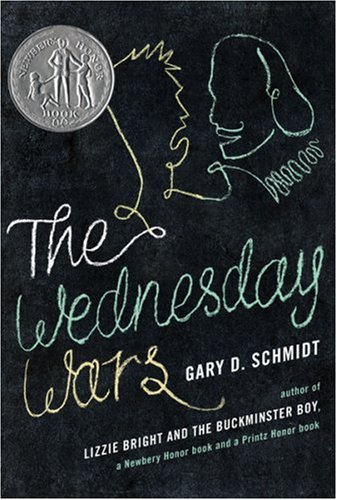
The Wednesday Wars


Schmidt, Gary. 2007. The Wednesday Wars. New York: Clarion Books. ISBN 0-618-72483-4.

     Holling Hoodhood is in the seventh grade. While all his friends are in either Hebrew or Catechism class, he stays in Mrs. Baker's class. Holling believes Mrs. Baker hates him because she makes him do chores, reads Shakespeare to him and is then, made to write essays and take exams on the plays. Everything seems to go wrong with Holling. Misadventures at school, at home and even meeting his hero, Mickey Mantle leads him to rely on his teacher and Shakespeare to come into his own.
     Set in Long Island in 1967, the Vietnam War is raging. According to my readings for this unit, the setting is an integral part to the story. Holling's family life is torn apart because of the war. His sister works for Bobby Kennedy's campaign, opposes the war and wants to go to Columbia University. Schmidt's in depth setting adds to the credibility of the story, especially featuring the Yankees, Mickey Mantle and the World Series. Young readers may identify with Holling because of his misfortune. Teens always think everything is going wrong in their lives. Holling deals with a teacher he thinks hates him, a couple of crazy rats, a bully who is after him for cream puffs, always fighting with his sister, a father who neglects him and a mother who sides with his father over her children. He and his sister are constantly arguing and fighting. But Holling saves her, not once but twice- once from a car accident and then, he goes after her after she is stranded across country. Teens are always fighting with the siblings but realize sooner or later, they love and care for another. I can see how teens may relate to Holling. Holling stands up to his father. It was refreshing how Schmidt's ties in Shakespeare's Much Ado About Nothing with Holling's "becoming a man" and a happy ending.
     The strength of The Wednesday Wars was the setting of the late 1960's. Holling's sisters involvement with civil right protests and Bobby Kennedy's campaign of course leads to discord within the family thus leading to Holling's family dynamics. I enjoyed how Schmidt integrates Shakespeare into the story: since I love Shakespeare.
     The Wednesday Wars won the 2008 Newberry Honor Book. Gillian Engberg for Booklist wrote: "Holling's unwavering, distinctive voice offers a gentle, hopeful, moving story of a boy who, with the right help, learns to stretch beyond the limitations of his family, his violent times, and his fear, as he leaps into his future with his eyes and his heart wide open." Another review from Booklist, which as starred noted: "Schmidt...makes the implausible believable and the everyday momentous...a gentle, hopeful, moving story."
     My favorite scene almost brought a tear to my eye. Holling goes to retrieve his sister:
     " 'Holling,' she said, 'I was so afraid I wouldn't find you.'
     'I was standing right here, Heather,' I said. 'I'll always be standing right here.' "

We are the Ship


Nelson, Kadir. 2008. We Are The Ship- The Story of Negro League Baseball. New York: Jump the Sun/Hyperion Books for Children. ISBN: 0-7868-0832-2

     The story about the Negro Baseball League, its development, its formation and its players and heroes.
     Nelson's social historical informational book about Negro baseball is visually stimulating, with his paintings from actual photographs. Commenting on the social climate and racism of the time, Nelson, depicts the unsung heroes and the league of the early days a baseball. Due to segregation, most players were "lost" and not mentioned in history. In keeping with the theme of baseball, the "chapters" of the book are entitled "Innings". For example, the first chapter is "1st Inning-Beginnings" and the last chapter is, of course, "9th Inning". The epilogue is titled "Extra Innings". The illustrations add to the remarkable design of the book, engrossing the reader into the passion of Nelson on this subject. Hank Aaron, former Negro baseball player, himslef and Hall of Famer, wrote the Foreword. The books reads like you are reading fiction-like story but filled with facts, scenes and information of the Negro League. It doesn't read not like a boring non-fiction book.
     The greatest strength of We Are... are the exquisite illustrations painted by Nelson himself. Photographs from the National Baseball Hall of Fame and the Negro Leagues Baseball Museum were created into portraits and used in the book. We Are... won the Coretta Scott King Award, the Coretta Scott King Illustrator Honor Award and the Sibert Medal. One reviewer wrote: "Social studies teachers and baseball fans of all ages will covet this delightful winner of the 2009 Coretta Scott King author award and illustrator Honor award.—Tricia Melgaard, Centennial Middle School, Broken Arrow, OK for School Library Journal. Ian Chipman for Booklist wrote: "With enormous blue skies and jam-packed grandstands backing them, these players look like the giants they are."
     At the end of the book, Nelson includes an Author's Note page, Acknowledgements, Bibliography, a filmography and End Notes for accuracy and citations.
     Between the title page and the Foreword, there are quotes from the players. My favorite one reads: "Baseball got me outta that celery field."- John Jordon "Buck" O'Neil, first baseman for the Kansas City Monarchs.

Hattie Big Sky


Larson, Kirby. 2006. Hattie Big Sky. New York: Delacorte Press. ISBN: 0-385-90332-4

     Hattie Inez Brooks is 16 years old. Orphaned, Hattie has inherited a land from an uncle she hardly knows in Montana. She takes on the responsibility in caring for the place. She has only eight months to make it or she will lose it all. She has help from her neighbors but she always feels alone and isolated. She has a friend, Charlie, who is serving over seas in France and a cat, Mr. Whispers. Hattie struggles with the harsh land and work but is filled with hope. Based on Larson's actual great grandmother's life.
     Hattie Big Sky is set in 1918. World War I is being fought overseas. I believe if the reader is a true fan of historical fiction, they will enjoy this book. Teenagers of that time worked hard in their family businesses or jobs. Family members have spoken to me about growing up and working as a child or teenager during the wars. Although, factuallycorrect, I don't believe teens would relate or identify with Hattie. The idea of working and toiling on a farm may seem alien to today's teenagers. Also, the letter writing that people did during the war is true and may be a sign of patriotism, letter writing is an ancient form of communication by today's standards. Today's teen are strangers to hard work and probably will not relate to Hattie's dilemma but may relate to her determination and perseverance. A 16 year old girl, living alone and having her own place will shock teens today. Although Larson's descriptions of the land may be beautiful, the long passages of working a farm will come across to today's teenagers as boring; especially when she talks about running from wild horses, building a fence and taking care of chickens. How boring is that to teens with cell phones, ipods and computers. Although, Larson's characters may be realistic and believable, the book may not to entertaining to teens of today. The theme of "hard work will persevere" and "true friendship will last" are unforgettable and timeless.  
     Hattie Big Sky won the 2007 Newberry Honor Book. One starred review from School Library Journal stated, “Larson creates a masterful picture of the homesteading experience and the people who persevered.” Kathleen Odean from Booklist wrote: "Larson, whose great-grandmother homesteaded alone in Montana, read dozens of homesteaders' journals and based scenes in the book on real events. Writing in figurative language that draws on nature and domestic detail to infuse her story with the sounds, smells, and sights of the prairie, she creates a richly textured novel full of memorable characters".
    I enjoyed the chapters starting off with either letters she has written to Charlie or articles Hattie has written for the newspaper. They (the letters or articles) seems to "catch" the reader up on what is happening. It is a strength to the novel. Not being a fan of historical fiction, it was a chore to read through this book; however, I particularly like the two recipes at the end of the book for Perilee's Spice Cake and Hattie's Biscuits.

Sunday, October 23, 2011

Uglies


Westerfeld, Scott. 2005. Uglies. New York: Simon Pulse. ISBN: 0689865384

     Tally Youngblood can't wait to move to New Pretty Town from Uglyville. She and her best friend, Peris love to sit at the edge of the river that divides Uglyville and New Pretty Town. She loves to listen to all the partying going on across the river and how beautiful the town is. In this dystopian society, when a teen turns sixteen, they are welcomed to New Pretty Town to become pretty. They have extensive plastic surgery to correct any "deformity", like a nose job and eliminate their weight problem by means of liposuction. Before its her turn, Tally meets Shay, another girl who tells Tally that turning pretty is not as perfect as it is crack up to be. Right before she turns 16, Tally is approached by government agents. They want Tally to spy and turn in a group of teens, of which Shay is a part of. If she doesn't comply, she will be ugly forever. She accepts; and spies on the "Smoke" but soon learns what the government's true plan of making everyone pretty really is. She Also meets David, who falls in love with her.
     Some aspects of science fiction, hover boarding and hover cars exist. Although, plastic surgery is a reality, the plastic surgery in the Uglies is so extreme it seems unreal, attributing to the characteristic of science fiction to incorporate science and modern technology. The protagonist is certainly adolescent and believable. Tally is certainly a victim when she is forced to spy on the Smoke in  order to be pretty. In the plot, events are plausible and definitely fast moving and exciting. The setting certainly moves the reader into an imaginary world and leads the reader to escape into a futuristic world. One theme residing in the Uglies is "if is sounds to good to be true, it probably probably isn't." Teens will relate to the theme of changing to change themselves, either how they look and how they are. Uglies have the government control society, evident in trying to apprehend the teens in the Smoke to make them conform and taking away their free will. Uglies tackles the topic of body image and plastic surgery, as well.
     For me, the strength of Uglies is the fast-paced action, particularly the fight in the woods. The romance between Tally and David is a bit refreshing among the action of this book. In my research, Uglies had not received any awards. Jennifer Mattson for Booklist wrote: "These elements, along with the obvious connections to reality programs such as Miami Slice, will surely cause this ingenious series debut to cement Westerfeld's reputation for high-concept YA fiction that has wide appeal."
    Without giving away the ending, I particularly like the last sentence of the book, which leads to the "cliffhanger" aspect: " 'I'm Tally Youngblood', she said. 'Make me pretty.' "