Sunday, October 23, 2011

Uglies


Westerfeld, Scott. 2005. Uglies. New York: Simon Pulse. ISBN: 0689865384

     Tally Youngblood can't wait to move to New Pretty Town from Uglyville. She and her best friend, Peris love to sit at the edge of the river that divides Uglyville and New Pretty Town. She loves to listen to all the partying going on across the river and how beautiful the town is. In this dystopian society, when a teen turns sixteen, they are welcomed to New Pretty Town to become pretty. They have extensive plastic surgery to correct any "deformity", like a nose job and eliminate their weight problem by means of liposuction. Before its her turn, Tally meets Shay, another girl who tells Tally that turning pretty is not as perfect as it is crack up to be. Right before she turns 16, Tally is approached by government agents. They want Tally to spy and turn in a group of teens, of which Shay is a part of. If she doesn't comply, she will be ugly forever. She accepts; and spies on the "Smoke" but soon learns what the government's true plan of making everyone pretty really is. She Also meets David, who falls in love with her.
     Some aspects of science fiction, hover boarding and hover cars exist. Although, plastic surgery is a reality, the plastic surgery in the Uglies is so extreme it seems unreal, attributing to the characteristic of science fiction to incorporate science and modern technology. The protagonist is certainly adolescent and believable. Tally is certainly a victim when she is forced to spy on the Smoke in  order to be pretty. In the plot, events are plausible and definitely fast moving and exciting. The setting certainly moves the reader into an imaginary world and leads the reader to escape into a futuristic world. One theme residing in the Uglies is "if is sounds to good to be true, it probably probably isn't." Teens will relate to the theme of changing to change themselves, either how they look and how they are. Uglies have the government control society, evident in trying to apprehend the teens in the Smoke to make them conform and taking away their free will. Uglies tackles the topic of body image and plastic surgery, as well.
     For me, the strength of Uglies is the fast-paced action, particularly the fight in the woods. The romance between Tally and David is a bit refreshing among the action of this book. In my research, Uglies had not received any awards. Jennifer Mattson for Booklist wrote: "These elements, along with the obvious connections to reality programs such as Miami Slice, will surely cause this ingenious series debut to cement Westerfeld's reputation for high-concept YA fiction that has wide appeal."
    Without giving away the ending, I particularly like the last sentence of the book, which leads to the "cliffhanger" aspect: " 'I'm Tally Youngblood', she said. 'Make me pretty.' "


Hunger Games

Collins, Suzanne. 2008. Hunger Games. New York: Scholastic. ISNB: 0439023483


     In an unknown dated future, the United States of America is divided into twelve districts. As punishment for trying to overthrow the government, the Capitol has mandated the each district send a teen girl and boy to compete to the death on live TV in the Hunger Games. With a win, the teens' family receives food, a new place to long and fame. District 12 has selected the 12 year old sister, Prim, of Katniss. Katniss takes her sister's place along with Peeta, the boy selected. They are taken to the Capitol and meet the couples from the other districts. They train for the Hunger Games. When the couples are introduced to the TV audience, Peeta tells everyone that he loves Katniss. This may provide an advantage because the audience can send things to help the teens survive. The audience feels for the "star-crossed lovers". They began the Hunger Games. Violently, the teens kill one another for survival. With only a few teens left, the "GameMakers" announce that if a district pair can win together. When Katniss and Peeta are the final two, the "GameMakers" change the rules and will make the teens compete against each other. Katniss and Peeta threaten suicide. The "GameMakers" give in to have two winners than none. They return to District 12 to fame and fanfare. Katniss was become political figure and Peeta is heartbroken because Katniss never really loved him. She rationalizes that it was for the game. But does she mean it?
     Since I have learned that a dystopian novels are neither fantasy nor science fiction, Hunger Games have characters of each. Though since the United States are now is ruins and considered "primitive" because people are staving and are making out meager living, still medicine, food and weapons can be "transported" to the competitors. Katniss quest is to survive and it's certainly a rite of passage. Her characteristics as representing every adolescent can be evident in that she must do what she is told and follow the rules. Her reluctance in taking her sister's place. She has both characteristics of being good and evil- she gathers food and takes care of he family but at the same time-she is a killer! She is strong and is an empowerment vibe about her. I recommend this book everything a girl ask for something to read. Accordingly to the characters of fantasy that I have learned, this plot, life and death situations are encountered- it's the main plot. And since this is the first of a trilogy, the conclusion is only the beginning of a new quest. The setting of the Hunger Games is believable. There are several themes in the Hunger Games. The one the is very evident of an 1984- government controlling society. The Capitol control the districts and its resource to benefit the whole country. It also controls their lives by having the Hunger Games, itself.
     The strength of this novel is the story itself. It is a fast read. I, myself, read the trilogy during Christmas break last year. The only weakness or criticism of the Hunger Games is the violence- in all three books for that matter.
     Hunger Games received Publisher's Weekly's "Best Book  2008", Booklist Editor Choice 2008 and Library Journal "Best Book 2008" Among the critics:  "Populated by three-dimensional characters, this is a superb tale of physical adventure, political suspense and romance." wrote Francisca Goldsmith for Booklist. And I found this on Amazon: "Let the games begin!" On September 12, 2008, Stephen King finds a new YA novel as scarily addictive as his favorite arcade game."

     It may be macabre of me but my favorite scene is when Rue, the twelve-year-old tribute from another district, is killed. I cried and cried. Rue and Katniss had formed an alliance. She is small and the reader feels pity for her. But, Katniss kills her assassin. Confronting Rue upon her death, Katniss sings to Rue. Rue dies and this gives Katniss the determination and confidence to win the Hunger Games.

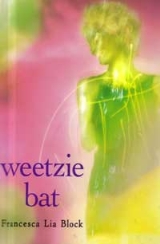
Weetzie Bat

Image Detail

Block, Francesca. 1989. Weetzie Bat. New York: HarperCollins Publisher. ISNB: 0064408183.

     Weetzie Bat loves old Hollywood. She lives in a fun-loving, party-filled, night-clubbing world Los Angeles, where she works as a waitress. Her gay best friend, Dirk go clubbing where they go "duck hunting". Weetzie is a weird and quirky individual. Right before Dirk's grandmother dies, she gives Weetzie is given a golden "thing". After polishing it, a genie grants Weetzie three wishes. She wants dirk to find someone to truly love. Weetzie wants a true love, too and a place to "live happily ever after" with Dirk. Dirk's grandmother leaves Dirk her house. He meets his true love named Duck and soon after Weetzie meets "My Secret Agent Lover Man". They soon make movies together and have a baby. Weetzie soon realizes her wishes have consequences.
       Weetzie Bat is just a weird and quirky read as Weetzie, herself is. The plot seems simple enough- three wishes granted. But as with all "wishes granted' plot something always goes wrong or does not go as the "wisher" intended. The scenes in the story, as one reads, jumps from one scene to the next but then returns to the original train of thought. This leans to confusion on the readers part. I became very confused in reading Weetzie Bat. Another aspect of the novel that confused me sometimes was the lingo and language used by Block. There were a couple times I had to re-read a passage because I didn't get it. Block does address topics such as sex, homosexuality and AIDS. Block also uses profanity in this book.
     Weetzie Bat doesn't follow the conventions of fantasy. Weetzie herself is not a quest. The only thing magical is the genie granting wishes. The story off-beat and weird, which may lead to the classification of it being fantasy.
     Weetzie Bat is Francesca Lia Block first novel. Oddly enough, Weetzie Bat was awarded the Phoenix Award by the Children's Literature Association. The Phoenix Award is bestowed on books that were did not receive an award at time of publication. The Phoenix symbolizes a rise from obscurity. (The Children's Literature Association- The Phoenix Award).  Publisher's Weekly wrote: "Block's first book is related in a breezy, knowing voice; her strange and sparkling tribute to growing up in L.A. is a rare treat for those sophisticated enough to appreciate it." Also, School Library Journal wrote; "...these kids spend no time considering college or career. Their only priority is finding love and keeping it once they find it. "
     My favorite phrase: Every time Weetzie is surprised, she yells, "Lanky Lizards!" I also enjoyed " 'I don't know about happily ever after. . .but I know about happily,' Weetzie Bat thought."

Notes from the Dog


Paulsen, Gary. 2009. Notes from the Dog. New York: Random House. 978-0-385-73845-3.

Finn was looking forward to the summer. Living with his dad, who is rarely at home, Finn was content to stay at home with his books and his dog, Dylan. Finn meets  his neighbor's house sitter, Johanna. Johanna befriends Finn and his friend, Matt. She is a beautiful grad student who is battling cancer. She hires Finn to build a garden in his own yard, with her guidance and supervision. Through bouts with chemotherapy, Finn and Matt become very close to Johanna, evidently both "falling" in love with her. Both raise money for her fundraiser and taking her place in a mini-triathlon. Through out the summer, Finn receives encouraging notes from Dylan. Who is sending them- his dad, Johanna or is it Dylan?
Set in a urban neighborhood, Finn visits Johanna next door, go into the downtown area and collects donation for Johanna. They walk to the park and visit his grandfather at the retirement village. He works in his garden but makes a mistake. In accordance with some characteristics of an adventure young adult fiction, Paulsen sets the task for making a garden for his main character- a task that will enter Finn into the adult world. He has to plan and set goals, go to the gardening store and interact with adults, and takes responsibility. Matt and Finn both care for Johanna when she get sick and helps her through her illness. Paulsen uses Dylan, the dog as part of the story to and tenderness. As one reads how Dylan comforts Johanna when she get sick, one becomes emotional. One can assume that Finn is a bit overweight, though it is not realized it until the end. One can correlate the symbolism of the garden to Johanna's illness and Finn's outlook on life. The mistake with the garden can symbolize the toll the chemo takes Johanna, but when the sprouts of grass emerge, Johanna slowly recovers and even Finn becomes friends with a girl from school. One of the strengths of this book is the role Dylan, the dog plays. He brings notes of encouragement to Finn and comforts Johanna when she get sick. One anticipates anytime Dylan appears in a story. Paulsen incorporates modern day familiars to attract young readers. Paulsen's Finn likes to be all alone, like most teenagers to. Finn has a broken family, single dad-who is too busy and no mom. Paulsen uses the verb "google" and also the characters use the internet and ipods. Although Paulsen didn't earn any awards with this book, Alison Follos of North County School of Lake Placid, wrote in School Library Journal, "Paulsen's fans may miss his trademarks: the notorious exploits of boys, the page-turning wilderness adventures, or the sled dogs that often take center stage. Yet this candid and tender tale, told with his signature humor, is a salute to the bravest of the brave."
The best passage is as follows:
" 'This is nice,' Dad said."You know, I didn't realize I was always at the library and never home. I like not rushing from work to class or study groups all the time. Sitting out here in the evenings with you is'- he draped and arm across my shoulders and looked around- 'the best part of my day.' "

Staying Fat for Sarah Byrnes


Crutcher, Chris. 1993. Staying Fat for Sarah Byrnes. New York: HarperCollins. 0-688-11552-7.

Eric and Sarah Byrnes are best friends- drawn together by their own "flaws". Eric is overweight and Sarah has disfiguring scars by a childhood kitchen accident. Of course, they are bullied and made fun of; but they gain strength from one another by being "outcast". They star publishing an underground newspaper. Eric joins the swim team and slims down but still remains friends with Sarah- but is torn to stay "fat" in order not to lose her friendship. After writing an expose on bully, Dale Thornton, Eric ans Sarah ask him to "protect" them. Now, Sarah is in hospital, catatonic. She just sits there not saying a thing. Eric visits her often and is encouraged by the staff to talk to her about "the good ole days". No one knows why Sarah is like that- only Sarah. She slowly begins to speak- only to Eric. She tells him she is faking because her father is going to kill her. Eric's favorite class is Contemporary American Thought (CAT) taught by Ms.Lemry. In this class, students voice their views on abortion, religion and other hot topics. Eric confides in Ms. Lemry and his swim coach. Together, they help Sarah escape her father, look for her mother and find themselves in danger.
     The plot of Staying Fat can be believable in that some readers will identify with the characters, not necessarily being fat or being disfigured but being bullied. It may be redeeming by the outcasts turning the tables on the bully by writing the expose. Crutcher's sport stories, of course features sports, here-swimming practices and swim meats. Sarah's character of being the strong one of the two by standing up for Eric, another characteristic of Crutcher sports stories. Other characteristics of Crutcher's is a challenge- saving Sarah; a budding romance between Eric and Sarah may be  viewed and of course, Crutcher's sense of humor. One true theme of this book is friendship. Obviuosly, Eric and Sarah are friends. They befriend their bully and become friends. Eric befriends his "rival" Mak Brittain.
One weakness of this book is the "flashback". One can be reading along when the scene suddenly switches to a flashback. It was a bi confusing when reading this book. However, these "flashback"can also be a strength in the novel, one can "catch up".
     "Staying Fat..." won the 1994 American Library Association Best Book for Young Adults and School Library Journal's Best Book in 1993. Publisher's Weekly wrote: "Superb plotting, extraordinary characters and crackling narrative make this novel one to be devoured in a single unforgettable sitting." School Library Journal published: "A story about a friendship with staying power, written with pathos and pointed humor."
     Favorite passage is:
' "So you think Sarah Byrnes's dad did something to her, like to her face?"
 "I don't know." he says, "but when I want to know about swimming, I asks Lemry. If I want to know about my teeth, I ask my dentist." He glances over. "Always go to the expert. If I wanted to know about hard times, I could do worse than to ask Dale Thornton." '


I'd Tell You I Love You But Then I'd Have to Kill You


Carter, Ally. 2006. I'd Tell You I Love You, But Then I'd Have to Kill You. New York: Hyperion.
1-4231-0003-4.


Cammie Morgan is 15 years old. She is a sophomore at Gallagher Academy For Expectational Young Women, which evidently her mom is headmistress. And, she is in love with Josh. Cammie has a lot of secrets, of which she can no tell Josh. She doesn't tell him what school she goes to because it is known as school of spoil rich heiresses. Cammie is not a heiress bu actually a spy. The Gallagher Academy For Expectational Young Women is actually a school to train young spies. She was actually on a mission when she met Josh. However, she and Josh start dating. But Cammie's life becomes a life of deceit. She sneaks out of school to see Josh and constantly lies to him to keep her cover. She lies about her school and home life. Her cover is blown when one of Josh's friend sees her enter the Academy. Cammie comes clean to Josh about everything. Josh breaks up with Cammie. As a final exam at school, Cammie is "kidnapped". Josh, thinking the kidnapping is real tries to rescue Cammie.
     Young adult mystery plots, characters etc don't have to be believable but they can be exaggerated as in this book. The first passage that made me realize that this was an out of the ordinary teen fiction was:
"After all, when you're on a plane home from Istanbul with a nuclear warhead in a hatbox, the last thing you want to do is write a report about it." It doesn't seem the typical girl falls for guy and tries to win him over book. It is adventure and mysterious but I want to read about the falling in love part. The exchanges between Josh and Cammie are believable. Some teens may identify with Cammie when she states that she like to disappear and be invisible, in the first line on this novel. However,one theme may be lying and deceit. Cammie has to constantly lie to Josh and lie more to cover up the first lie. She has to sneak out of school to see him and make sure n one is following her when she returns. In following with characteristics of a mystery young adult novel, Cammie is clearly in a romantic relationship her clear focus and problem is to keep Josh away from her true identity. And just like all, mysteries, all the ends of the mystery/adventure tie up nicely.
     Although, this book didn't win any major literary awards, it is a fun book to read. The book may be made into movie, which I can see with the "spy" theme. One critic wrote: 
"However, the novel has been optioned for a film and will likely attract readers who enjoy lighthearted, frothy tales and squeaky-clean romances.Unfortunately, it lacks the warmth and appeal of other teen books turned into movies, such as Meg Cabot's The Princess Diaries (HarperCollins, 2000) and Ann Brashares's The Sisterhood of the Traveling Pants (Delacorte, 2001."–Miranda Doyle, San Francisco Public Library for School Library Journal.