Wednesday, November 23, 2011

American Born Chinese


Yang, Gene Luen. 2006. American Born Chinese. New York: First Second. 1-59643-152-0.

     In this comic-style book, three seemingly unrelated stories: that of the ancient Chinese folktale of the Monkey King, a young boy tries to fit in with his schoolmates and a young man embarrassed every year by his visiting cousin from China; all become intertwined in a surprising ending.
     All three characters, the Monkey King, Jin Wang and Danny have one thing in common; they are trying to fit in and try to find their identity, but get laughed at in the process. With the subtopic of realistic fiction of self identity, all three characters are searching for a sense of self, exploring the "purpose" in school, at home and with friends and holding on to those friendships. In trying to find their identity each one encounters prejudice, discrimination and comments that are on the verge of racism. Aside from ancient China, the setting of Danny and Jin's tale are primarily in school. Although transporting back and forth from ancient China and modern-day high school adds to the style of the book. Chin-Kee, Danny's cousin, character is over-the-top, stereo-typical and almost racist. However, this leads to the over-all charm of the book and the moral of all three stories.
     American Born Chinese won several awards for this book and its artwork: 2006 A National Book Award finalist, 2007 ALA's Printz Award winner, 2007 Eisner Award for Best Graphic Album and the 2007 Havey Award for Best Colorist (Lark Pien). VOYA's Sherrie Williams wrote: "This graphic novel first appeared as a long running Web comic on http://www.Moderntales.com, where it enjoyed an enthusiastic following. The artwork is clean and distinctive, with varying panel styles and inking that is visually appealing." Jesse Karp for Booklist stated: "Yang helps the humor shine by using his art to exaggerate or contradict the words, creating a synthesis that marks an accomplished graphic storyteller. The stories have a simple, engaging sweep to them, but their weighty subjects--shame, racism, and friendship--receive thoughtful, powerful examination."
     My favorite passage comes at the end, where all three stories fit together. The Monkey King is sitting talking to Jin: " 'You know, Jin, I would have saved myself for five hundred years' imprisonment beneath mounatin of rock had I only realiuzes how good it is to be a monkey." '

Zombie Haiku


Mecum, Ryan. 2008. Zombie Haiku. Cincinnati, Ohio: How Books. ISBN: 1600610706.

     Chris L. has written a "haiku journal" documenting a zombie plague. He first hides from the zombies but is soon turned into one. He writes about eating people and staying within the zombie group. Soon rigor mortis sets in and he can't move anymore. His last entries are about his wife.
     This novel-in-verse, in this case, haiku, will dispel any preconceived notions to teens that poetry has to rhyme or needs to be written in iambic pentameter. Teens will love these zombie haikus. They will also like the simplicity of haiku and how easy and fast this book will read. Chris's encounters are humorous but at the same time gross- giving zombie behavior. Teens will enjoy the blood-stained pages, disgusting illustrations and horrid zombie photos throughout the book; which is the strength of the novel. Teens will also get a thrill of the description of zombie-life and how Chris L. survives as a zombie.
     A book description from Amazon stated: "Poetry is dead. "Zombie Haiku" is the touching story of a zombie's gradual decay told through the intimate poetry of haiku. From infection to demise, readers will accompany the narrator through deserted streets and barricaded doors for every eye-popping, gut-wrenching, flesh-eating moment. The book is illustrated with over 50 photos from the zombie's point of view and designed with extra blood, pus, gore, and guts!" "A thoroughly unique and entertaining experience. Ryan Mecum has quite possibly found the only corner of entertainment not yet infected by the zombie plague--haiku--and made me wonder why it took this long, as the two seem to go together like zombies and brains. I highly recommend it to fans of all things zombie." wrote Robert Kirkman, author of The Walking Dead and Marvel Zombies and "The most inventive zombie book in years!" stated David Wellington, author of Monster Island.
     There are several haikus I enjoyed: some made me laugh while others made me cringed. These haikus appeared separately throughout the book.

Something on the news
about people acting odd,
so I switch to sports.

The slow walk takes days.
A speeding car hits a pole,
so we get a snack.

I know he can't see
because the room is pitch black
and I have his eyes.

I can't wait to read Vampire Haiku and Werewolf Haiku.

The Rose That Grew From Concrete


Shakur, Tupac. 1999. The Rose That Grew From Concrete. New York: Pocket Books. ISBN: 0-671-02845-6

     Poems written when he was 19-year old and published after his death, Tupac reveals his inner-most thoughts and feelings of his surrounding and his hope for the future.
     Some of today's teens may not know who Tupak is, while others hail him as divinity. Tupak is a martyr in some of their eyes, while others view him as a thug and hoodlum. According to the introduction, written by his manager, Leila Steinberg, Tupak's pre-rapper existence was full of passion for the arts inspite of his poverty; some much so that this book and his works have encompassed world-wide advocacy for the arts. Compiled by his manager and mother, Tupak's poetry and artwork lines one side of the page, while the poem featured is typed out on the other. The strength of this book is the original poems written in Tupak's own hand, photocopied. There are little doodles and drawings in his original pieces that decorate and seem to bring the poems to life. There are also a few pictures of Tupak. the preface was written by his mother.
     Susan Salpini for School Library Journal wrote: "A collection of poetry written by the rapper between 1989 and 1991, before he became famous. The poems are passionate, sometimes angry, and often compelling." The product descirption form Amazon stated: "His talent was unbounded, a raw force that commanded attention and respect. His death was tragic -- a violent homage to the power of his voice.
His legacy is indomitable -- remaining vibrant and alive. Here now, newly discovered, are Tupac's most honest and intimate thoughts conveyed through the pure art of poetry -- a mirror into his enigmatic life and its many contradictions. Written in his own hand at the age of nineteen, they embrace his spirit, his energy...and his ultimate message of hope."
     Although I am not a big fan of poetry nor of Tupak, I read through this book and found I liked this poem. It sounds like a lot of teens can relate to being alone and no one caring.


Sometimes I Cry

Sometimes when I'm alone
I cry because I'm on my own
The tears I cry R bitter and warm
They flow with life but take no form
I cry because my heart is torn
and I find it difficult 2 carry on
If I had an ear 2 confide in
I would cry among my treasured friends
But who do u know that stops that long
to help another carry on
The world moves fast and it would rather pass u by
than 2 stop and c what makes u cry
It's painful and sad and sometimes I cry
and no one cares about why.

Saturday, November 12, 2011

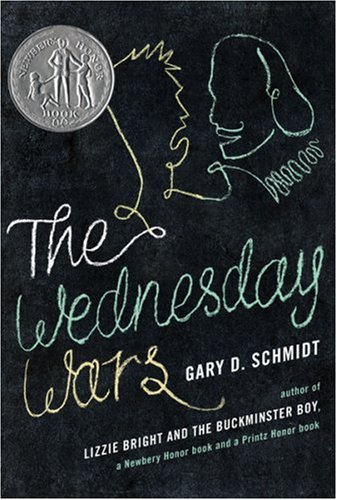
The Wednesday Wars


Schmidt, Gary. 2007. The Wednesday Wars. New York: Clarion Books. ISBN 0-618-72483-4.

     Holling Hoodhood is in the seventh grade. While all his friends are in either Hebrew or Catechism class, he stays in Mrs. Baker's class. Holling believes Mrs. Baker hates him because she makes him do chores, reads Shakespeare to him and is then, made to write essays and take exams on the plays. Everything seems to go wrong with Holling. Misadventures at school, at home and even meeting his hero, Mickey Mantle leads him to rely on his teacher and Shakespeare to come into his own.
     Set in Long Island in 1967, the Vietnam War is raging. According to my readings for this unit, the setting is an integral part to the story. Holling's family life is torn apart because of the war. His sister works for Bobby Kennedy's campaign, opposes the war and wants to go to Columbia University. Schmidt's in depth setting adds to the credibility of the story, especially featuring the Yankees, Mickey Mantle and the World Series. Young readers may identify with Holling because of his misfortune. Teens always think everything is going wrong in their lives. Holling deals with a teacher he thinks hates him, a couple of crazy rats, a bully who is after him for cream puffs, always fighting with his sister, a father who neglects him and a mother who sides with his father over her children. He and his sister are constantly arguing and fighting. But Holling saves her, not once but twice- once from a car accident and then, he goes after her after she is stranded across country. Teens are always fighting with the siblings but realize sooner or later, they love and care for another. I can see how teens may relate to Holling. Holling stands up to his father. It was refreshing how Schmidt's ties in Shakespeare's Much Ado About Nothing with Holling's "becoming a man" and a happy ending.
     The strength of The Wednesday Wars was the setting of the late 1960's. Holling's sisters involvement with civil right protests and Bobby Kennedy's campaign of course leads to discord within the family thus leading to Holling's family dynamics. I enjoyed how Schmidt integrates Shakespeare into the story: since I love Shakespeare.
     The Wednesday Wars won the 2008 Newberry Honor Book. Gillian Engberg for Booklist wrote: "Holling's unwavering, distinctive voice offers a gentle, hopeful, moving story of a boy who, with the right help, learns to stretch beyond the limitations of his family, his violent times, and his fear, as he leaps into his future with his eyes and his heart wide open." Another review from Booklist, which as starred noted: "Schmidt...makes the implausible believable and the everyday momentous...a gentle, hopeful, moving story."
     My favorite scene almost brought a tear to my eye. Holling goes to retrieve his sister:
     " 'Holling,' she said, 'I was so afraid I wouldn't find you.'
     'I was standing right here, Heather,' I said. 'I'll always be standing right here.' "

We are the Ship


Nelson, Kadir. 2008. We Are The Ship- The Story of Negro League Baseball. New York: Jump the Sun/Hyperion Books for Children. ISBN: 0-7868-0832-2

     The story about the Negro Baseball League, its development, its formation and its players and heroes.
     Nelson's social historical informational book about Negro baseball is visually stimulating, with his paintings from actual photographs. Commenting on the social climate and racism of the time, Nelson, depicts the unsung heroes and the league of the early days a baseball. Due to segregation, most players were "lost" and not mentioned in history. In keeping with the theme of baseball, the "chapters" of the book are entitled "Innings". For example, the first chapter is "1st Inning-Beginnings" and the last chapter is, of course, "9th Inning". The epilogue is titled "Extra Innings". The illustrations add to the remarkable design of the book, engrossing the reader into the passion of Nelson on this subject. Hank Aaron, former Negro baseball player, himslef and Hall of Famer, wrote the Foreword. The books reads like you are reading fiction-like story but filled with facts, scenes and information of the Negro League. It doesn't read not like a boring non-fiction book.
     The greatest strength of We Are... are the exquisite illustrations painted by Nelson himself. Photographs from the National Baseball Hall of Fame and the Negro Leagues Baseball Museum were created into portraits and used in the book. We Are... won the Coretta Scott King Award, the Coretta Scott King Illustrator Honor Award and the Sibert Medal. One reviewer wrote: "Social studies teachers and baseball fans of all ages will covet this delightful winner of the 2009 Coretta Scott King author award and illustrator Honor award.—Tricia Melgaard, Centennial Middle School, Broken Arrow, OK for School Library Journal. Ian Chipman for Booklist wrote: "With enormous blue skies and jam-packed grandstands backing them, these players look like the giants they are."
     At the end of the book, Nelson includes an Author's Note page, Acknowledgements, Bibliography, a filmography and End Notes for accuracy and citations.
     Between the title page and the Foreword, there are quotes from the players. My favorite one reads: "Baseball got me outta that celery field."- John Jordon "Buck" O'Neil, first baseman for the Kansas City Monarchs.

Hattie Big Sky


Larson, Kirby. 2006. Hattie Big Sky. New York: Delacorte Press. ISBN: 0-385-90332-4

     Hattie Inez Brooks is 16 years old. Orphaned, Hattie has inherited a land from an uncle she hardly knows in Montana. She takes on the responsibility in caring for the place. She has only eight months to make it or she will lose it all. She has help from her neighbors but she always feels alone and isolated. She has a friend, Charlie, who is serving over seas in France and a cat, Mr. Whispers. Hattie struggles with the harsh land and work but is filled with hope. Based on Larson's actual great grandmother's life.
     Hattie Big Sky is set in 1918. World War I is being fought overseas. I believe if the reader is a true fan of historical fiction, they will enjoy this book. Teenagers of that time worked hard in their family businesses or jobs. Family members have spoken to me about growing up and working as a child or teenager during the wars. Although, factuallycorrect, I don't believe teens would relate or identify with Hattie. The idea of working and toiling on a farm may seem alien to today's teenagers. Also, the letter writing that people did during the war is true and may be a sign of patriotism, letter writing is an ancient form of communication by today's standards. Today's teen are strangers to hard work and probably will not relate to Hattie's dilemma but may relate to her determination and perseverance. A 16 year old girl, living alone and having her own place will shock teens today. Although Larson's descriptions of the land may be beautiful, the long passages of working a farm will come across to today's teenagers as boring; especially when she talks about running from wild horses, building a fence and taking care of chickens. How boring is that to teens with cell phones, ipods and computers. Although, Larson's characters may be realistic and believable, the book may not to entertaining to teens of today. The theme of "hard work will persevere" and "true friendship will last" are unforgettable and timeless.  
     Hattie Big Sky won the 2007 Newberry Honor Book. One starred review from School Library Journal stated, “Larson creates a masterful picture of the homesteading experience and the people who persevered.” Kathleen Odean from Booklist wrote: "Larson, whose great-grandmother homesteaded alone in Montana, read dozens of homesteaders' journals and based scenes in the book on real events. Writing in figurative language that draws on nature and domestic detail to infuse her story with the sounds, smells, and sights of the prairie, she creates a richly textured novel full of memorable characters".
    I enjoyed the chapters starting off with either letters she has written to Charlie or articles Hattie has written for the newspaper. They (the letters or articles) seems to "catch" the reader up on what is happening. It is a strength to the novel. Not being a fan of historical fiction, it was a chore to read through this book; however, I particularly like the two recipes at the end of the book for Perilee's Spice Cake and Hattie's Biscuits.

Sunday, October 23, 2011

Uglies


Westerfeld, Scott. 2005. Uglies. New York: Simon Pulse. ISBN: 0689865384

     Tally Youngblood can't wait to move to New Pretty Town from Uglyville. She and her best friend, Peris love to sit at the edge of the river that divides Uglyville and New Pretty Town. She loves to listen to all the partying going on across the river and how beautiful the town is. In this dystopian society, when a teen turns sixteen, they are welcomed to New Pretty Town to become pretty. They have extensive plastic surgery to correct any "deformity", like a nose job and eliminate their weight problem by means of liposuction. Before its her turn, Tally meets Shay, another girl who tells Tally that turning pretty is not as perfect as it is crack up to be. Right before she turns 16, Tally is approached by government agents. They want Tally to spy and turn in a group of teens, of which Shay is a part of. If she doesn't comply, she will be ugly forever. She accepts; and spies on the "Smoke" but soon learns what the government's true plan of making everyone pretty really is. She Also meets David, who falls in love with her.
     Some aspects of science fiction, hover boarding and hover cars exist. Although, plastic surgery is a reality, the plastic surgery in the Uglies is so extreme it seems unreal, attributing to the characteristic of science fiction to incorporate science and modern technology. The protagonist is certainly adolescent and believable. Tally is certainly a victim when she is forced to spy on the Smoke in  order to be pretty. In the plot, events are plausible and definitely fast moving and exciting. The setting certainly moves the reader into an imaginary world and leads the reader to escape into a futuristic world. One theme residing in the Uglies is "if is sounds to good to be true, it probably probably isn't." Teens will relate to the theme of changing to change themselves, either how they look and how they are. Uglies have the government control society, evident in trying to apprehend the teens in the Smoke to make them conform and taking away their free will. Uglies tackles the topic of body image and plastic surgery, as well.
     For me, the strength of Uglies is the fast-paced action, particularly the fight in the woods. The romance between Tally and David is a bit refreshing among the action of this book. In my research, Uglies had not received any awards. Jennifer Mattson for Booklist wrote: "These elements, along with the obvious connections to reality programs such as Miami Slice, will surely cause this ingenious series debut to cement Westerfeld's reputation for high-concept YA fiction that has wide appeal."
    Without giving away the ending, I particularly like the last sentence of the book, which leads to the "cliffhanger" aspect: " 'I'm Tally Youngblood', she said. 'Make me pretty.' "


Hunger Games

Collins, Suzanne. 2008. Hunger Games. New York: Scholastic. ISNB: 0439023483


     In an unknown dated future, the United States of America is divided into twelve districts. As punishment for trying to overthrow the government, the Capitol has mandated the each district send a teen girl and boy to compete to the death on live TV in the Hunger Games. With a win, the teens' family receives food, a new place to long and fame. District 12 has selected the 12 year old sister, Prim, of Katniss. Katniss takes her sister's place along with Peeta, the boy selected. They are taken to the Capitol and meet the couples from the other districts. They train for the Hunger Games. When the couples are introduced to the TV audience, Peeta tells everyone that he loves Katniss. This may provide an advantage because the audience can send things to help the teens survive. The audience feels for the "star-crossed lovers". They began the Hunger Games. Violently, the teens kill one another for survival. With only a few teens left, the "GameMakers" announce that if a district pair can win together. When Katniss and Peeta are the final two, the "GameMakers" change the rules and will make the teens compete against each other. Katniss and Peeta threaten suicide. The "GameMakers" give in to have two winners than none. They return to District 12 to fame and fanfare. Katniss was become political figure and Peeta is heartbroken because Katniss never really loved him. She rationalizes that it was for the game. But does she mean it?
     Since I have learned that a dystopian novels are neither fantasy nor science fiction, Hunger Games have characters of each. Though since the United States are now is ruins and considered "primitive" because people are staving and are making out meager living, still medicine, food and weapons can be "transported" to the competitors. Katniss quest is to survive and it's certainly a rite of passage. Her characteristics as representing every adolescent can be evident in that she must do what she is told and follow the rules. Her reluctance in taking her sister's place. She has both characteristics of being good and evil- she gathers food and takes care of he family but at the same time-she is a killer! She is strong and is an empowerment vibe about her. I recommend this book everything a girl ask for something to read. Accordingly to the characters of fantasy that I have learned, this plot, life and death situations are encountered- it's the main plot. And since this is the first of a trilogy, the conclusion is only the beginning of a new quest. The setting of the Hunger Games is believable. There are several themes in the Hunger Games. The one the is very evident of an 1984- government controlling society. The Capitol control the districts and its resource to benefit the whole country. It also controls their lives by having the Hunger Games, itself.
     The strength of this novel is the story itself. It is a fast read. I, myself, read the trilogy during Christmas break last year. The only weakness or criticism of the Hunger Games is the violence- in all three books for that matter.
     Hunger Games received Publisher's Weekly's "Best Book  2008", Booklist Editor Choice 2008 and Library Journal "Best Book 2008" Among the critics:  "Populated by three-dimensional characters, this is a superb tale of physical adventure, political suspense and romance." wrote Francisca Goldsmith for Booklist. And I found this on Amazon: "Let the games begin!" On September 12, 2008, Stephen King finds a new YA novel as scarily addictive as his favorite arcade game."

     It may be macabre of me but my favorite scene is when Rue, the twelve-year-old tribute from another district, is killed. I cried and cried. Rue and Katniss had formed an alliance. She is small and the reader feels pity for her. But, Katniss kills her assassin. Confronting Rue upon her death, Katniss sings to Rue. Rue dies and this gives Katniss the determination and confidence to win the Hunger Games.

Weetzie Bat

Image Detail

Block, Francesca. 1989. Weetzie Bat. New York: HarperCollins Publisher. ISNB: 0064408183.

     Weetzie Bat loves old Hollywood. She lives in a fun-loving, party-filled, night-clubbing world Los Angeles, where she works as a waitress. Her gay best friend, Dirk go clubbing where they go "duck hunting". Weetzie is a weird and quirky individual. Right before Dirk's grandmother dies, she gives Weetzie is given a golden "thing". After polishing it, a genie grants Weetzie three wishes. She wants dirk to find someone to truly love. Weetzie wants a true love, too and a place to "live happily ever after" with Dirk. Dirk's grandmother leaves Dirk her house. He meets his true love named Duck and soon after Weetzie meets "My Secret Agent Lover Man". They soon make movies together and have a baby. Weetzie soon realizes her wishes have consequences.
       Weetzie Bat is just a weird and quirky read as Weetzie, herself is. The plot seems simple enough- three wishes granted. But as with all "wishes granted' plot something always goes wrong or does not go as the "wisher" intended. The scenes in the story, as one reads, jumps from one scene to the next but then returns to the original train of thought. This leans to confusion on the readers part. I became very confused in reading Weetzie Bat. Another aspect of the novel that confused me sometimes was the lingo and language used by Block. There were a couple times I had to re-read a passage because I didn't get it. Block does address topics such as sex, homosexuality and AIDS. Block also uses profanity in this book.
     Weetzie Bat doesn't follow the conventions of fantasy. Weetzie herself is not a quest. The only thing magical is the genie granting wishes. The story off-beat and weird, which may lead to the classification of it being fantasy.
     Weetzie Bat is Francesca Lia Block first novel. Oddly enough, Weetzie Bat was awarded the Phoenix Award by the Children's Literature Association. The Phoenix Award is bestowed on books that were did not receive an award at time of publication. The Phoenix symbolizes a rise from obscurity. (The Children's Literature Association- The Phoenix Award).  Publisher's Weekly wrote: "Block's first book is related in a breezy, knowing voice; her strange and sparkling tribute to growing up in L.A. is a rare treat for those sophisticated enough to appreciate it." Also, School Library Journal wrote; "...these kids spend no time considering college or career. Their only priority is finding love and keeping it once they find it. "
     My favorite phrase: Every time Weetzie is surprised, she yells, "Lanky Lizards!" I also enjoyed " 'I don't know about happily ever after. . .but I know about happily,' Weetzie Bat thought."

Notes from the Dog


Paulsen, Gary. 2009. Notes from the Dog. New York: Random House. 978-0-385-73845-3.

Finn was looking forward to the summer. Living with his dad, who is rarely at home, Finn was content to stay at home with his books and his dog, Dylan. Finn meets  his neighbor's house sitter, Johanna. Johanna befriends Finn and his friend, Matt. She is a beautiful grad student who is battling cancer. She hires Finn to build a garden in his own yard, with her guidance and supervision. Through bouts with chemotherapy, Finn and Matt become very close to Johanna, evidently both "falling" in love with her. Both raise money for her fundraiser and taking her place in a mini-triathlon. Through out the summer, Finn receives encouraging notes from Dylan. Who is sending them- his dad, Johanna or is it Dylan?
Set in a urban neighborhood, Finn visits Johanna next door, go into the downtown area and collects donation for Johanna. They walk to the park and visit his grandfather at the retirement village. He works in his garden but makes a mistake. In accordance with some characteristics of an adventure young adult fiction, Paulsen sets the task for making a garden for his main character- a task that will enter Finn into the adult world. He has to plan and set goals, go to the gardening store and interact with adults, and takes responsibility. Matt and Finn both care for Johanna when she get sick and helps her through her illness. Paulsen uses Dylan, the dog as part of the story to and tenderness. As one reads how Dylan comforts Johanna when she get sick, one becomes emotional. One can assume that Finn is a bit overweight, though it is not realized it until the end. One can correlate the symbolism of the garden to Johanna's illness and Finn's outlook on life. The mistake with the garden can symbolize the toll the chemo takes Johanna, but when the sprouts of grass emerge, Johanna slowly recovers and even Finn becomes friends with a girl from school. One of the strengths of this book is the role Dylan, the dog plays. He brings notes of encouragement to Finn and comforts Johanna when she get sick. One anticipates anytime Dylan appears in a story. Paulsen incorporates modern day familiars to attract young readers. Paulsen's Finn likes to be all alone, like most teenagers to. Finn has a broken family, single dad-who is too busy and no mom. Paulsen uses the verb "google" and also the characters use the internet and ipods. Although Paulsen didn't earn any awards with this book, Alison Follos of North County School of Lake Placid, wrote in School Library Journal, "Paulsen's fans may miss his trademarks: the notorious exploits of boys, the page-turning wilderness adventures, or the sled dogs that often take center stage. Yet this candid and tender tale, told with his signature humor, is a salute to the bravest of the brave."
The best passage is as follows:
" 'This is nice,' Dad said."You know, I didn't realize I was always at the library and never home. I like not rushing from work to class or study groups all the time. Sitting out here in the evenings with you is'- he draped and arm across my shoulders and looked around- 'the best part of my day.' "

Staying Fat for Sarah Byrnes


Crutcher, Chris. 1993. Staying Fat for Sarah Byrnes. New York: HarperCollins. 0-688-11552-7.

Eric and Sarah Byrnes are best friends- drawn together by their own "flaws". Eric is overweight and Sarah has disfiguring scars by a childhood kitchen accident. Of course, they are bullied and made fun of; but they gain strength from one another by being "outcast". They star publishing an underground newspaper. Eric joins the swim team and slims down but still remains friends with Sarah- but is torn to stay "fat" in order not to lose her friendship. After writing an expose on bully, Dale Thornton, Eric ans Sarah ask him to "protect" them. Now, Sarah is in hospital, catatonic. She just sits there not saying a thing. Eric visits her often and is encouraged by the staff to talk to her about "the good ole days". No one knows why Sarah is like that- only Sarah. She slowly begins to speak- only to Eric. She tells him she is faking because her father is going to kill her. Eric's favorite class is Contemporary American Thought (CAT) taught by Ms.Lemry. In this class, students voice their views on abortion, religion and other hot topics. Eric confides in Ms. Lemry and his swim coach. Together, they help Sarah escape her father, look for her mother and find themselves in danger.
     The plot of Staying Fat can be believable in that some readers will identify with the characters, not necessarily being fat or being disfigured but being bullied. It may be redeeming by the outcasts turning the tables on the bully by writing the expose. Crutcher's sport stories, of course features sports, here-swimming practices and swim meats. Sarah's character of being the strong one of the two by standing up for Eric, another characteristic of Crutcher sports stories. Other characteristics of Crutcher's is a challenge- saving Sarah; a budding romance between Eric and Sarah may be  viewed and of course, Crutcher's sense of humor. One true theme of this book is friendship. Obviuosly, Eric and Sarah are friends. They befriend their bully and become friends. Eric befriends his "rival" Mak Brittain.
One weakness of this book is the "flashback". One can be reading along when the scene suddenly switches to a flashback. It was a bi confusing when reading this book. However, these "flashback"can also be a strength in the novel, one can "catch up".
     "Staying Fat..." won the 1994 American Library Association Best Book for Young Adults and School Library Journal's Best Book in 1993. Publisher's Weekly wrote: "Superb plotting, extraordinary characters and crackling narrative make this novel one to be devoured in a single unforgettable sitting." School Library Journal published: "A story about a friendship with staying power, written with pathos and pointed humor."
     Favorite passage is:
' "So you think Sarah Byrnes's dad did something to her, like to her face?"
 "I don't know." he says, "but when I want to know about swimming, I asks Lemry. If I want to know about my teeth, I ask my dentist." He glances over. "Always go to the expert. If I wanted to know about hard times, I could do worse than to ask Dale Thornton." '


I'd Tell You I Love You But Then I'd Have to Kill You


Carter, Ally. 2006. I'd Tell You I Love You, But Then I'd Have to Kill You. New York: Hyperion.
1-4231-0003-4.


Cammie Morgan is 15 years old. She is a sophomore at Gallagher Academy For Expectational Young Women, which evidently her mom is headmistress. And, she is in love with Josh. Cammie has a lot of secrets, of which she can no tell Josh. She doesn't tell him what school she goes to because it is known as school of spoil rich heiresses. Cammie is not a heiress bu actually a spy. The Gallagher Academy For Expectational Young Women is actually a school to train young spies. She was actually on a mission when she met Josh. However, she and Josh start dating. But Cammie's life becomes a life of deceit. She sneaks out of school to see Josh and constantly lies to him to keep her cover. She lies about her school and home life. Her cover is blown when one of Josh's friend sees her enter the Academy. Cammie comes clean to Josh about everything. Josh breaks up with Cammie. As a final exam at school, Cammie is "kidnapped". Josh, thinking the kidnapping is real tries to rescue Cammie.
     Young adult mystery plots, characters etc don't have to be believable but they can be exaggerated as in this book. The first passage that made me realize that this was an out of the ordinary teen fiction was:
"After all, when you're on a plane home from Istanbul with a nuclear warhead in a hatbox, the last thing you want to do is write a report about it." It doesn't seem the typical girl falls for guy and tries to win him over book. It is adventure and mysterious but I want to read about the falling in love part. The exchanges between Josh and Cammie are believable. Some teens may identify with Cammie when she states that she like to disappear and be invisible, in the first line on this novel. However,one theme may be lying and deceit. Cammie has to constantly lie to Josh and lie more to cover up the first lie. She has to sneak out of school to see him and make sure n one is following her when she returns. In following with characteristics of a mystery young adult novel, Cammie is clearly in a romantic relationship her clear focus and problem is to keep Josh away from her true identity. And just like all, mysteries, all the ends of the mystery/adventure tie up nicely.
     Although, this book didn't win any major literary awards, it is a fun book to read. The book may be made into movie, which I can see with the "spy" theme. One critic wrote: 
"However, the novel has been optioned for a film and will likely attract readers who enjoy lighthearted, frothy tales and squeaky-clean romances.Unfortunately, it lacks the warmth and appeal of other teen books turned into movies, such as Meg Cabot's The Princess Diaries (HarperCollins, 2000) and Ann Brashares's The Sisterhood of the Traveling Pants (Delacorte, 2001."–Miranda Doyle, San Francisco Public Library for School Library Journal.

Wednesday, September 21, 2011

Angus, Thongs and Full-Frontal Snogging

Image Detail

Rennison, Louise. 1999. Angus, Thongs and Full-Frontal Snogging. New York: HarperCollins Publishers. ISBN: 0-06-028814-0.

SUMMARY:
This book is about the life and times of Georgia Nicolson as written through her diary. Georgia lives with her mother, father, baby sister and a crazy cat named Angus. she has a best friend named Jas and they hang out with other friends. they share their inner most thoughts, spend a lot of time with each other and talk about their favorite subject-BOYS!  Georgia falls in love with Robbie and Jas falls for Robbie's brother, Tom. But, Robbie starts seeing Lindsay, Georgia's rival- oh, and how will Georgia ever get her true love.

CRITICAL ANALYSIS:
Set in England, this whimsical dairy-styled young adult book, follow the oh-so dramatic life of Georgia Nicolson and her friends. The characters in this novel will be identified with by teens. Teens in England are the same as teens in America. They go out, fall in love, have sleep-over and talk about the opposite sex.
they have rivals who they compete against to win their heart's desire.

LITERARY CRITERIA:
"Angus,...," truly follows the literacy criteria for realistic young adult novels. One can quickly read and follow Georgia's thoughts and feelings. The plot is believable in that teens are going through the same things the characters are. Through the setting of England may be exotic for most American teens, it will be appreciated. Written in journal style will appeal to teens- who doesn't want to read someone else's diary.

STRENGTHS/WEAKNESSES:
Even though, the humor may be an asset to Angus,..., it may be a weakness. It is a British import and British humor may not be understood by American teens. Teens may be confused by "the Queen's English" used in this book, so much so a glossary of terms are listed at the end of the book.

AWARDS AND OTHER REVIEWS:
Nestlé Children's Book Prize: (UK award, awarded by a charity, BookTrust)
The Branford Boase Award: British literary award presented annually to an outstanding novel for
        young people by a first-time writer
2001 Michael L. Printz Honor Book

From Booklist:
"...her Georgia is a wonderful character whose misadventures are not only hysterically funny but universally recognizable. This "fabbity, fab, fab" novel will leave readers cheering, "Long live the teen!" and anxiously awaiting the promised sequel."
 Michael Cart
Copyright © American Library Association. All rights reserved

From School Library Journal:
"It will take a sophisticated reader to enjoy the wit and wisdom of this charming British import, but those who relish humor will be satisfied. Fresh, lively, and engaging."
Angela J. Reynolds, Washington County Cooperative Library Services, Aloha, OR
Copyright 2000 Reed Business Information, Inc.

FAVORITE LINES/ PASSAGES:
"6:00 pm
'Do you think Robbie really said I was sad and I flung myself on him?'
Jas was a real pal. "No, no of course not...er...you didn't, did you?'

6:30 pm
Oh why this? Why would he be such a pig as to say that? Oh I hate him, I hate him.

midnight
I hate him, I hate him

12:30 am
Oh I love him, I love him"

BOOK HOOK:
In the teen section of the public library, a teen librarian may set up a display of teenage angst and name it some thing like, "So, you think you life sucks?!" and then place every book for this mod on display.

The Earth, My Butt and other Big Round Things


Mackler, Carolyn. 2003. The Earth, My Butt and other Big Round Things. Cambridge, MA: CandleWick Press. ISBN: 0-7636-2091-2.

SUMMARY:
Fifteen-year old Ginny is goes to a private high school, is from a well-to-do family and she is fat. Ginny is very uncomfortable and self-conscious about it. She doesn't want anyone to see her body so she wears over-size clothes and does not allow her "make-out" buddy to touch her. Ginny has her own set of "Fat Girl Code of Conduct" that she lives by. Her mother is an adolescent psychologist and is constantly nagging on Ginny about her weight. Her dad is hardly around. Her sister is in the Peace Corp (actually to escape their mother). her big brother is home having been kick out of school for date rape. Ginny finally stand up for herself, stands up to her mother and finds the self-confidence she was lacking.

CRITICAL ANALYSIS:
Ginny's character is identifiable with teen girls going through the same thing, Even through her humor, one can see over-weight teen girls giggling wile reading this book. Even though the setting of this book is Manhattan, it not very well used to develop the story. Meaning, after the setting is set and is not part of the story, it could be taken for granted that this story can happen everywhere. The plot may be exaggerated a bit, but it is still believable in Ginny's character. The Earth,... is written in first-person and in keeping up with today's technology, Ginny uses e-mail and she also uses a journal in her narrative.

LITERARY CRITERIA:
The plot of The Earth, ..., is very believable. One can visualize Ginny and what is happening to her. Her character allows the reader to feel her thoughts and feelings. As noted above, the setting is not well defined and can lead the reader that the story can happen everywhere. Written in the first person, Ginny also uses email and journal to tell her story. Although, this story is about an over-weight teen girl, and will obviously appeal to this general audience, the humor and how Ginny's character looks at her life and what she is going through and how she handles herself will appeal to others.

STRENGTHS/WEAKNESSES:
Ginny's character is the strength of this book. Her outlook on life, though her own, will enchant any reader.
One weakness is on Ginny's character thinking about self-mutilation and is not really developed.

AWARDS AND OTHER REVIEWS:
Michael L. Printz Award for Honor Book
American Library Association Best Book for Young Adults

From Booklist:
"But Mackler writes with such insight and humor (sometimes using strong language to make her point) that many readers will immediately identify with Virginia's longings as well as her fear and loathing. Her gradually evolving ability to stand up to her family is hard won and not always believable, but it provides a hopeful ending for those trying stand on their own two feet."
Ilene Cooper Copyright © American Library Association. All rights reserved

From School Library Journal:
"Some passages are very well done, but the book has an uneven quality in prose style and character development. Told through first-person narrative, journal entries, and e-mail, Virginia's story will interest readers who are looking for one more book with teen angst, a bit of romance, and a kid who is a bit like them or their friends."
Gail Richmond, San Diego Unified Schools, CA
Copyright 2003 Reed Business Information, Inc.

FAVORITE LINES/ PASSAGES:
The Fat Girl's Code of Conduct

BOOK HOOK:
Curriculum themes: Self- confidence, self-worth, self-acceptance, date rape, eating disorders, self-mutilation.


Boy Meets Boy


Levithan, David. 2003. Boy Meets Boy. New York: Random House. ISBN: 0-375-92400-0.


SUMMARY:
Paul goes out with his best friends, Joni and Tony. Paul and Joni have been friends since forever and she was the one he came out to in elementary school. Tony is also gay and lives with his parents, who have a problem with his homosexually. Paul meets Noah and while getting to know each other, they find out that they have been under each other's noses all along and begin dating. After breaking up with Ted, Joni begins to date Chuck, football player and a bully to Infinite Darlene, another football player who cross-dresses. Chuck and Toni's relationship upsets Ted, Paul and Infinite Darlene. Paul's ex, Kyle wants to get back with Paul, but Paul is deeply in love with Noah. Kyle had spread a rumor that Paul turned him "gay". Cautiously Paul let Kyle in after he apologizes for all he did and became friends again. Kyle is uncertain about his own sexuality and Paul is there for a shoulder to lean on. Paul tells Joni about his renewed friendship with Kyle and she in turns tells Chuck. Chuck begins to run a "pool" on which Paul will choose.
While dealing with his parents, Tony goes hiking 't fell the same.Paul. After the hike, Tony hugs Paul for listening, only to be scene, all rumors start flying. Noah breaks up with Paul, after hearing the rumor and also hearing that Paul kissed Kyle. Later, Kyle reveals to Paul that he stills loves him but Paul doesn't feel the same. Paul talks to Tony about Kyle but Paul reveals his feelings about his sexually and his parents' relationship with him. Paul wants to win back Noah; he has a seven day plan to get Noah back. For seven days, Paul carries out little task, such as origami on Noah's locker, a list of what he likes about Noah, a love song and finally confronting him. Noah is swept off his feet, he agrees to go to a dance with Paul. Everyone meets a Tony's house, since Tony's parents would not let him go to the dance with a date but rather in a group, to go to the dance.

CRITICAL ANALYSIS:
Set in a libel town in New Jersey, that accepts the sexuality of its teen residents, the characters can live freely and as normal as their straight counterparts. Without this setting, the plot would not have flowed as it does. The characters are adorable and can be identified by young readers who may be going through, either gay or straight. As a supported of gay rights, one will enjoy a refreshing setting and plot involving gay teens.

LITERARY CRITERIA:
Boy meets Boy has some of the characteristics of a romantic novels, it has romance, both gay and straight. It had a happy ending (oops)! It contain a slight exaggerations. It certainly conveys hope and youthfulness. Adults readers may feel joy in finishing this book. It does pair likable couples (Paul and Noah), it is believable in nature, and it had a love-at-first-sight moment. The plot is based on what teens will go through, falling in love, falling out of love, rumors and bullying. As mention above, the setting enhances the plot and characters. It does posses a smoothness in style, it reads fast, keeping the reader interested in its plot and characters.

STRENGTHS/WEAKNESSES:
The greatness strength of this book is the openness of teen homosexuality, bisexually and trangenderness. With all the recent new reports of hate crimes against gay teens, suicides and a campaign against bullying, this novel portrays gay teen just as regular teens, with rumors, jealousy, betrayal and the ins and outs of teen life.
The weakness of the very ins and outs of teen life- OK, who is dating who, he kisses who, why is she seeing him, it makes one head spin. Although, teens readers will follow the quick reader and fast-paced plot, an adult reader may get confessed.

AWARDS AND OTHER REVIEWS:
2003 Lambda Literary Award

“In its blithe acceptance and celebration of human differences, this is arguably the most important gay novel since Annie on My Mind and seems to represent a revolution in the publishing of gay-themed books for adolescents.”—Booklist, Starred

“Levithan’s prophecy of a hate-free world in which everyone loves without persecution makes this a provocative and important read for all young adults, gay or straight.”—School Library Journal, Starred

FAVORITE LINES/ PASSAGES:
Once again, it's the last scene: "what a wonderful world."

BOOK HOOK:
Curriculum themes: teen homosexuality, bisexually and transgender, acceptance, tolerance, bullyness, "nature vs nurture" debate (born this way or learner traits).


Sylvia M. Verdell, 2003.

Friday, September 2, 2011

John Lennon: All I Want is the Truth

Image Detail

Partridge, Elizabeth. 2005. John Lennon: All I Want is the Truth. New York: Viking.
ISBN: 0-670-05954-4

SUMMARY: 
A photographic biography of the legendary John Lennon- from being raised by his aunt and uncle in Liverpool, England to his tragic murder on New York City.

CRITICAL ANALYSIS:
A true Beatle-manic and any rabid John Lennon fan will truly enjoy this book. The photos and pictures are the backbone of this book. Partridge transports the reader to Liverpool in the 1940, where John was raised by his relatives, his troublesome childhood, teenage antics, the formation and being a Beatle; even life after The Beatles. Partridge also takes the reader through post-Beatle life with Yoko and to his horrific murder in New York and his legacy.

LITERARY CRITERIA:
According to Verdell's Children's Literature in Action, literary criteria for biographies are accuracy, organization, design and style.
Partridge's accuracy is evident at the end of her book. Along with a regular bibliography, she includes "Source Notes". Chapter by chapter, Partridge list the source of the quote(s) or fact(s) by who stated it or where she acquired it. Also, there is a "Photograph Credit" page, listing the sources of all the photos in the book. She organized this book chronologically. In her introduction, she begins her book with "Bed-in for Peace" event. Partridge covers Lennon from birth to death and even his legacy. The design is magnificent. Photos and pictures, all in black and white, add to the grand overall beauty of the book. Though a non-fiction book, Partridge's style reads as a story than an informational book.

STRENGTHS AND WEAKNESSES:
The greatest strength of this book is obviously to photos and pictures of The Beatles. Some may be disappointed with not a lot of information of the other Beatles, but it would not be a Lennon biography. 

AWARDS AND OTHER REVIEWS:
Bccb Blue Ribbon Nonfiction Book Award

Young adult readers will be riveted, and Partridge is fair and open with the facts... book design is drop-dead gorgeous... -- The Horn Book Magazine, starred review

   Partridge cuts through the mythology and misinformation surrounding the life of the legendary singer/songwriter and goes a long way toward revealing the complexities of his personality. From School Library Journal


FAVORITE LINES/ PASSAGES:
All the photographs and pictures

BOOK HOOK:
Music history, John Lennon, and The Beatles.

Verdell, Sylvia. 2008. Children's Literature in Action. Westport, CT: Libraries Unlimited.

The Absolutely True Diary of a Part-Time Indian


Alexie, Sherman. Art by Ellen Forney. 2007. The Absolute True Diary of a Part-Time Indian. New York: Little, Brown and Company. ISBN: 0-316-01368-4

SUMMARY:
Arnold Spirit, Junior, to those on the Spokane Indian Reservation, had it bad the minute he was born. Arnold was born with Hydrocephalus, commonly known as "water on the brain". He is ridiculed and bullied all the time. Rowdy, the biggest bully torments him, but they are best friends. In order to break the cycle of poverty Arnold is in, he decides he wants to attend school off the "rez". He enrolls in a "white" school twenty miles away. At the new school, Arnold is exposed and experiences things he's never been through, such as dances, field trips and even falling in love. Arnold makes new friends with the "popular" kids and the "nerdy" ones, too. He even makes the basketball team.

CRITICAL ANALYSIS:
Alexie's characters will enthrall the reader into this book. Written in the first person, Alexie's Arnold humorously takes the reader onto the reservation, connects one into the daily life and tragedies Arnold endures- hunger, walking twenty miles some days to get to school, deaths of family and friends. Set in a reservation in Spokane, WA, one is enlightened by Indian culture, in a Pow Wow and poverty on the reservation. Arnold's conflict of finding his own identity outside the "rez" is a self vs. self plot. But also his conflict of "betraying" his own culture leads to the plot of self vs. society and self vs.culture. Young readers will applaud Arnold for believing in himself and adventuring out of his comfort and experience life of the "rez".

LITERARY CRITERIA:
Readers will care for his characters. One will feel when Arnold goes through his trials and tribulations, to the point of crying while reading this book. The plot flows as readers follows Arnold events in his life. Obviously, the setting affects Arnold's story. The poverty and alcoholism among others on the "rez" directly molds Arnold's desire to escape. With the first person point of view style, readers will again feel what Arnold's is going through. The relevent theme of trying to find yourself in the room, coping with friends and family and going through "growing pains" in life is eviden in Arnold's story.

STRENGTHS AND WEAKNESSES:
The greatest strengths in this novel was the humor in the writing and the cartoons accompanying some of the passages. Though, some may question and/or be offended by the portrayal of Native Americans in this novel, Alexie wrote to bring out the authenticity of this particular culture. One can see how others can object to language and the sexual "talk" between young boys, again, "it is how it is".

AWARDS AND OTHER REVIEWS:
"Realistic and fantastical and funny and tragic-all at the same time." (VOYA (starred review) )
"Alexie's humor and prose are easygoing and well suited to his young audience." (Booklist )
"[Alexie] has created an endearing teen protagonist in his own likeness and placed him in the here and now." (Minneapolis Star Tribune )

FAVORITE LINES/ PASSAGES:  My favorite scene is the very last scene of the book:
   "Rowdy and I played one-on-one for hours. We played until dark. We played until the streetlights lit up the court. We played until the bats swooped down at our heads. We played until the moon was huge and golden and perfect in the dark sky.
    We didn't keep score."

BOOK HOOK:
Incorporate in these curriculum themes: Native Americans, family life, alcoholism, escapism, self-confidence, determination and self-esteem.

The Chocolate War


Cormier, Robert. 1974. Chocolate War. New York: Dell Laurel-Leaf. ISBN: 0-440-94459-7

SUMMARY:
Freshman Jerry Renault attends Trinity School, a private Catholic all-boy preparatory high school. Jerry plays football and conforms to the rules of the school. But when the annual chocolate fundraiser arrives, Jerry refuses to sell any. Everyone is shocked! Under the command of the Vigils, a secret school society, Jerry is told not to sell the candy for ten days. However, after the teen days, he still refuses to sell. This disrupts the power of the Vigils and of the school. The Vigils harass and bully Jerry. He is even beaten up by the biggest school bully. Still, Jerry won't budge. In a final stance in this chocolate war, the Vigils set-up a boxing match in which the school body chooses the blows.

CRITICAL ANALYSIS:
Written in the third-person and set on a private high school, Cormier characters were vivid and with little chapters devoted to them allows the reader into each personality. There are several themes in this book and they may be reveal to each reader differently: standing up for yourself, believing in yourself, non-conformity. Jerry experiences self vs self conflict, with the quotation in his locker reading, "Do I dare disturb the universe". Jerry also exhibits the self vs. others, by conflicting with the Vigils and with society, with the school.

LITERARY CRITERIA:
The conflict between characters is the whole story of The Chocolate War. The defiance of Jerry, the power-hungry Archie, the teddy-bear Goubert and the others is the whole story. It may the setting also that may to the story, since the story rarely occurs off campus. The theme of self-questioning and Jerry's sexual frustration also add to the story; the reader sees a bit into Jerry's persona. The plot flows as a great story building up to its climax.

STRENGTHS AND WEAKNESSES:
In the beginnings of the novel, Cormier writes small chapters to reveal the persona of each character, how they interact with other and their happening.
A weakness may be that this is a "boy book". Girls may find it hard to get through it.

AWARDS AND OTHER REVIEWS:
An ALA Best Books for Young Adults

A School Library Journal Best Books of the Year

A Kirkus Reviews Choice

A New York Times Outstanding Books of the Year

"The characterizations of all the boys are superb...  This novel [is] unique in its uncompromising portrait of human cruelty and conformity."-School Library Journal, starred review

"The novel is cleverly written with a good sense of the realistic and a good ear for dialogue, qualities which will attract any reader."-Bestsellers

FAVORITE LINES/ PASSAGES:
After slapping Bailey in the face and accusing him of cheating, Brother Leon says this to the class:
"You poor fools," he said. "You idiots. Do you know who's the best one here? The bravest of all?" He placed his hand on Bailey's shoulder. "Gregory Bailey, that's who. He denied cheating, He stood his ground! But you, gentlemen, you sat there and enjoyed yourselves. And those of you who didn't enjoy yourselves allowed it to happen, allowed me to proceed. You turned this classroom into Nazi Germany for a few moments. Yes, yes someone finally protested. Aw, let the kid alone." Mimicking the deep voice perfectly. " A feeble protest, too little and too late." ... He turned to Bailey, touched the top of this head with the pointer as if he were bestowing knighthood. "You did well, Bailey. I'm proud of you. You passed the biggest test of all- you were true to yourself."

BOOK HOOK:
Curriculum themes to be considered: Bullying, self-confidence, self-believing, defiance, "secret societies"and conformity.

Monday, August 29, 2011

Hello!

Hi! My name is Sylvia. I've created this blog for my Advanced Young Adult Literature Class at Texas Woman's University for my Master of Library Science degree.